We use cookies to improve your experience on our website. By continuing you acknowledge cookies are being used.

Investment market review - Quarter ended 30 June 2026
- Title
- Investment market review - Quarter ended 30 June 2026
The Research Team provides a performance summary and commentary on each of the five main asset classes.
Australian shares
The domestic economic backdrop softened over the quarter, with indicators pointing to weaker business and consumer confidence, moderate employment growth, and persistent inflationary pressures. In response, the Reserve Bank of Australia (RBA) tightened monetary policy further, increasing the cash rate in May after increases in February and March. Cost-of-living pressures remain a headwind for household spending, with implications for consumer-sensitive sectors of the economy.
The Federal Budget also introduced proposed changes to capital gains tax and negative gearing arrangements, creating additional uncertainty for the residential property sector and potentially influencing housing market activity.
Australian equities delivered a solid return of 4.1% over the quarter, although different sub-sectors of the market performed quite differently. Market leadership rotated during the period, with several sectors recovering strongly following weakness earlier in the year. Information Technology was the standout performer, returning 17.4%, while Australian listed property gained 13.5%, reflecting improved sentiment and a recovery from prior valuation pressure.
The Energy sector was the primary detractor, declining 16.7% as oil and natural gas prices retreated as geopolitical tensions eased due to the Iran–US ceasefire. Health Care also underperformed, falling 6.1%, driven by weaker earnings outlooks from major companies including Cochlear and CSL.
| 3-month return (%) | 1 year (% p.a.) | 10 year (% p.a.) |
|---|---|---|---|
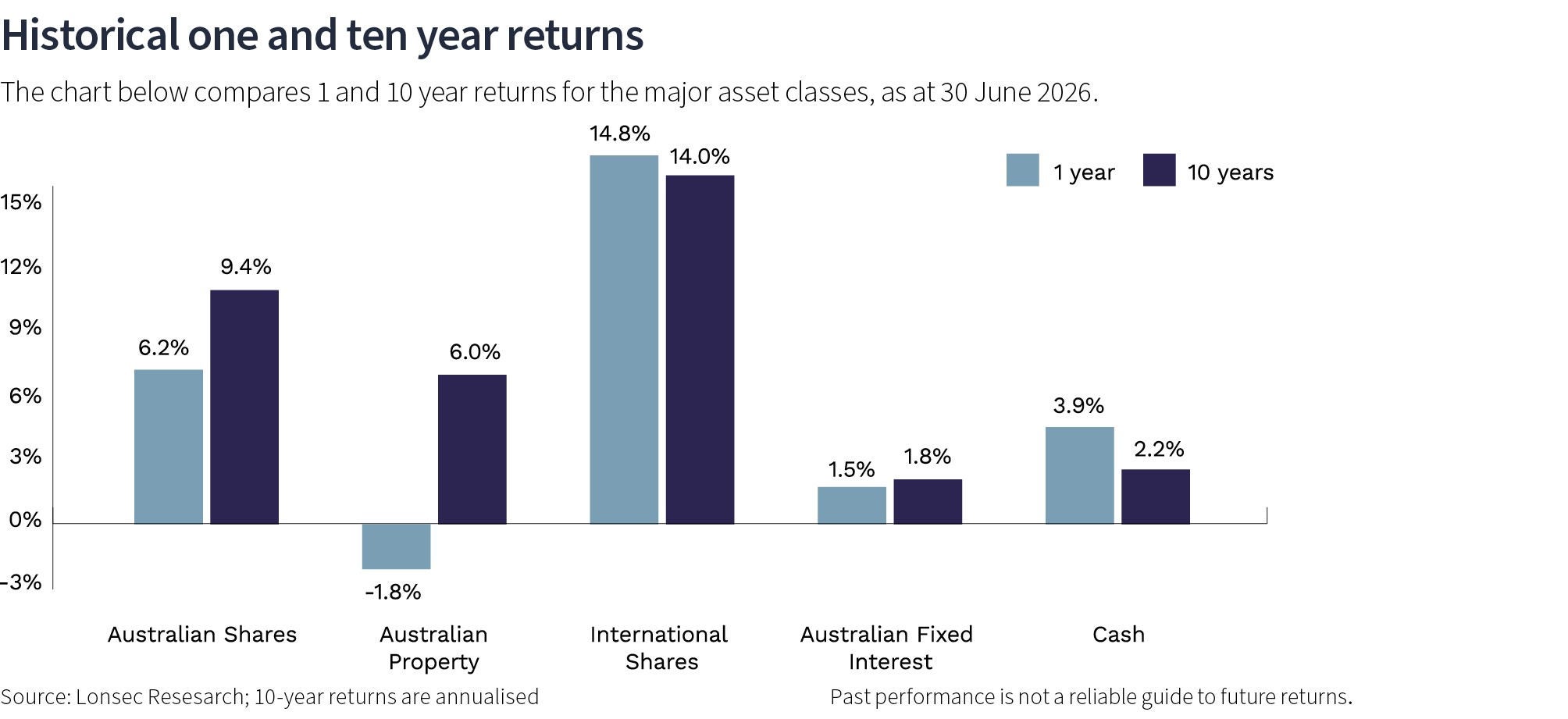
| Australian shares | 4.10 | 6.2 | 9.4 |
S&P/ASX 300 Accumulation Index
Australian listed property trusts
The Australian listed property trusts delivered a strong recovery during the quarter ended 30 June 2026, with the S&P/ASX 300 A-REIT Index returning 13.6%, significantly outperforming the broader Australian equity market. The rebound was driven by improving investor sentiment towards interest rate-sensitive assets as inflation moderated and expectations grew that the RBA was nearing the end of its monetary tightening cycle.
Performance remained mixed across property sectors. Industrial and logistics REITs continued to outperform, supported by structural demand from e-commerce, supply chain investment and digital infrastructure, while retail REITs benefited from resilient consumer spending, stable occupancy and positive leasing conditions. In contrast, office REITs continued to face challenging operating conditions due to elevated vacancy rates, subdued leasing demand and the ongoing impact of hybrid working arrangements.
The outlook for Australian listed property has improved as the macroeconomic environment becomes more supportive. Industrial, logistics and specialised property sectors remain well positioned to deliver sustainable earnings growth, while future performance across the broader A-REIT market depends on the path of interest rates and the resilience of commercial property fundamentals.
| 3-month return (%) | 1 year (% p.a.) | 10 year (% p.a.) |
|---|---|---|---|
| Australian listed property trusts | 13.6 | -1.8 | 6.0 |
S&P/ASX 300 A-REIT Index
International shares
Global equities bounced delivering 12.5% in the June quarter as markets looked through the oil crisis, confident that a resolution would avoid any further escalation that would severely undermine the global economy. Investor sentiment was initially weakened by the outbreak of conflict between Iran and the US in late February, resulting in a sharp market decline during March. However, the announcement of a ceasefire in April prompted a strong recovery in global equity markets, with improving sentiment supporting broad-based gains.
In the US, enthusiasm surrounding artificial intelligence (AI) continued to be a key driver of equity market performance, with major indices reaching record highs during the quarter. The S&P 500 and Nasdaq gained 14.9% and 21.4% respectively in the June quarter. Large technology companies, including Alphabet, Amazon, Microsoft and Nvidia, continued to increase investment in AI-related infrastructure and capabilities, supporting both corporate earnings expectations and broader economic activity.
Asian equity markets also recovered strongly after experiencing significant volatility earlier in the quarter. South Korea and Taiwan were standout performers, recording local currency returns of 89.7% and 48.3%, respectively, as investors anticipated robust demand for semiconductors and other AI-related technologies. In contrast, Chinese equities declined -6.9%, reflecting ongoing concerns over subdued consumer spending, weakness in the property sector and a slower-than-expected economic recovery.
| 3-month return (%) | 1 year (% p.a.) | 10 year (% p.a.) |
|---|---|---|---|
International shares | 12.5 | 14.8 | 14.0 |
MSCI World Index – Net Total Return (AUD)
Australian Fixed interest
Bond markets returned 2.7% during the second quarter of 2026, despite the RBA extending its tightening cycle with a further cash rate increase to 4.35% in May. Performance was supported by the attractive carry from bond yields, resilient credit spreads and strong investor demand.
Australia’s 10-year government bond yield climbed to around 4.8% by quarter end, reaching a three-week high as global oil prices rose amid renewed US-Iran tensions. Despite ongoing global interest rate volatility and local inflation risks, Australian credit markets remained stable, with credit indices broadly unchanged and spreads relatively tight.
Australia’s bond market also saw an influx of offshore issuers, with international borrowers such as German Commerzbank and Spanish CaixaBank issuing bonds in our market. Australia’s bond market continued to benefit from deeper liquidity and growing offshore participation.
| 3-month return (%) | 1 year (% p.a.) | 10 year (% p.a.) |
|---|---|---|---|
Australian Fixed interest | 2.7 | 1.5 | 1.8 |
Bloomberg AusBond Composite Index
Cash
The benchmark for the Australian cash market continued to rise over the second quarter of 2026. RBA increased the cash rate at the May meeting and left it unchanged in June at 4.35%, reflecting continued concern around above-target inflation, a still-tight labour market and uncertainty around energy prices.
The annual CPI eased slightly to 4.0% in May 2026 from 4.2% in April, below expectations of 4.4% but remaining well above the RBA’s 2-3% target. The moderation was driven by softer goods inflation, which eased to 4.2% from 4.7%, with transport costs slowing to 3.3% from 6.6% in April as automotive fuel inflation moderated to 7.7% from 18.6% in February.
Geopolitical risks and energy price uncertainty continued to add to inflation risks during Q2, contributing to volatility in short-term yields and bank bill rates. However, sentiment improved later in the quarter as oil prices eased and expectations for further near-term rate hike moderated.
| 3-month return (%) | 1 year (% p.a.) | 10 year (% p.a.) |
|---|---|---|---|
| Cash | 1.1 | 3.9 | 2.2 |
Bloomberg AusBond Bank Bill Index