We use cookies to improve your experience on our website. By continuing you acknowledge cookies are being used.

Investment market review - Quarter ended 30 September 2026
- Title
- Investment market review - Quarter ended 30 September 2026
The Research Team provides a performance summary and commentary on each of the five main asset classes.
Australian shares
The Australian economy continues to face notable challenges as elevated inflation and higher interest rates weigh on economic activity. Reserve Bank Australia (RBA) has increased the cash rate by 0.25% to 4.60% in the September 2026 meeting.
Australian equities delivered a modest return of 1.3% over the quarter, although performance varied significantly across sectors. Several sectors that experienced weakness earlier in the year staged a notable recovery in recent months. The Health Care sector was a standout performer, returning +25.4% for the quarter, supported by renewed investor interest in companies such as Cochlear and CSL, which were increasingly viewed as attractively valued. The Energy sector also generated strong gains, driven by rising oil and gas prices amid escalating tensions in the Middle East, while the Resources sector benefited from higher commodity and metal prices.
The Consumer Discretionary sector felt the pressure of increasing interest rates and softer consumer spending, falling -10.0% over the quarter.
| 3-month return (%) | 1 year (% p.a.) | 10 year (% p.a.) |
|---|---|---|---|
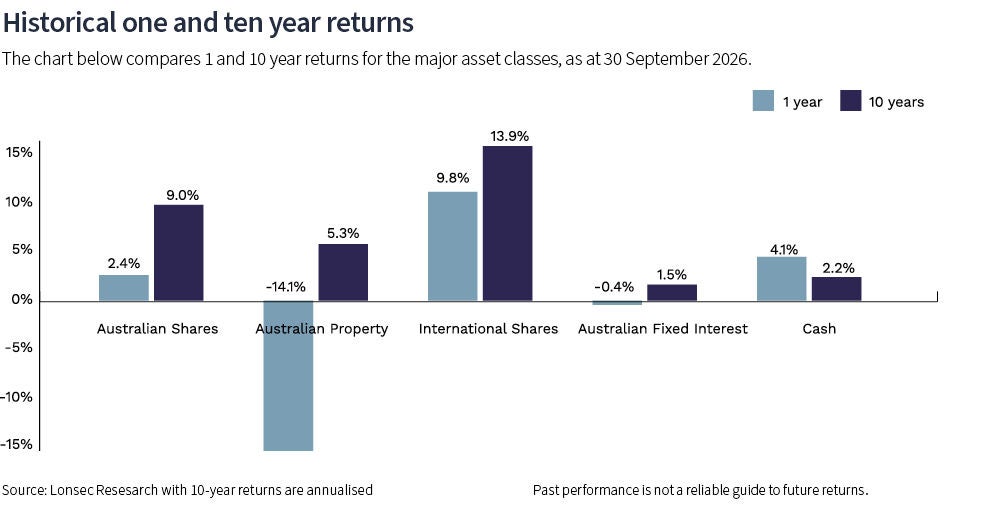
| Australian shares | 1.3 | 2.4 | 9.0 |
S&P/ASX 300 Accumulation Index
Australian listed property trusts
The Australian listed property trust sector declined -8.4% during the quarter, significantly underperforming the broader Australian equity market. The performance highlighted the sector's sensitivity to changes in bond yields, as higher discount rates place downward pressure on property valuations and reduce the relative appeal of rental yields.
Performance across the A-REIT sector remained varied, reflecting differences in asset exposure, balance sheet quality and earnings prospects. Industrial and logistics REITs continued to benefit from long-term structural demand driven by e-commerce growth and supply chain investment, although rental growth eased from the exceptionally strong levels recorded in recent years. Retail-focused REITs were supported by resilient occupancy rates and steady tenant demand, while the office sector continued to face headwinds from challenging leasing conditions, lower occupancy levels and the need for ongoing asset repositioning.
While current valuations and distribution yields may present attractive opportunities for long-term investors, a sustained recovery across the sector will likely require greater confidence in the interest rate environment and clearer evidence that property valuations have stabilised.
| 3-month return (%) | 1 year (% p.a.) | 10 year (% p.a.) |
|---|---|---|---|
| Australian listed property trusts | -8.4 | -14.1 | 5.3 |
S&P/ASX 300 A-REIT Index
International shares
Despite ongoing geopolitical tensions and persistent inflationary pressures global equity markets remain cautiously positive delivering 1.5% return, supported by resilient global economic growth, solid corporate earnings and continued capital investment in AI technology and digital infrastructure. The US is expected to remain a key driver of global equity returns, supported by strong technology investment, productivity opportunities and robust corporate profitability. However, elevated valuations in selected technology and AI-related companies increase the risk of market volatility if earnings growth fails to meet investor expectations. As a result, the sustainability of corporate earnings and the ability of businesses to convert significant AI investment into tangible productivity gains will remain important considerations for investors.
Market performance varied across regions. US and Japanese equities posted solid gains, supported by robust corporate earnings and strength in technology and financial sectors, while the UK also advanced, led by energy stocks. In contrast, Eurozone equities declined modestly and emerging markets delivered slightly negative returns, weighed down by rising bond yields, higher oil prices and renewed Middle East tensions. Within Asia ex Japan, performance was mixed, with weakness in South Korea and India offset by stronger returns in Singapore and China, reflecting differing economic conditions and sector exposures across the region.
Looking ahead, technology stocks particularly those associated with AI, continued to support broader market performance, while interest-rate-sensitive sectors such as utilities and real estate underperformed.
| 3-month return (%) | 1 year (% p.a.) | 10 year (% p.a.) |
|---|---|---|---|
International shares | 1.5 | 9.8 | 13.9 |
MSCI World Index – Net Total Return (AUD)
Australian Fixed interest
Australian fixed-interest markets declined -1.5% during the third quarter of 2026. The 3-year Australian Government bond yield increased from approximately 4.4% at the end of June to around 4.9% at the end of September, meanwhile, the 10-year bond yield also climbed from approximately 4.8% to 5.3%. Note, the price of a bond decreases as yields rise.
The market was influenced by persistent inflationary pressures, elevated energy prices and shifting expectations for tighter monetary policy. Higher-than-expected inflation data, including the August headline CPI increase to 4.0%, which prompted investors to reassess the outlook for interest rates and price in a more restrictive monetary policy stance. Meanwhile, elevated oil prices, with Brent crude rising above US$100 per barrel amid escalating Middle East geopolitical tensions, added to near-term inflation risks and contributed to upward pressure on bond yields.
Although rising yields weighed on bond prices and resulted in capital losses over the quarter, higher prevailing yields improved prospective income opportunities for fixed income investors. Active core Australian bond funds are providing attractive carry and income potential, although actual returns over the near term will remain sensitive to inflation developments, central bank decisions and further movements in market yields.
| 3-month return (%) | 1 year (% p.a.) | 10 year (% p.a.) |
|---|---|---|---|
Australian Fixed interest | -1.5 | -0.4 | 1.5 |
Bloomberg AusBond Composite Index
Cash
The benchmark for the Australian cash market delivered a positive return of approximately 1.11% over the September 2026 quarter. Short-term cash and bank bill investments remained an attractive source of stable income, while the index's low-duration profile limits exposure to the price volatility experienced by longer-dated fixed income assets.
The Reserve Bank of Australia (RBA) also increased the cash rate by 0.25% to 4.60% in September, marking its highest level in 15 years. The decision reflected ongoing concerns about elevated inflation and the potential for further price pressures arising from higher global energy costs and domestic capacity constraints. The August CPI data of 4.0% p.a. came in above expectations and supports market expectations that additional monetary policy tightening may be required in the months ahead.
The stubbornly higher than desired inflation backdrop complicates the monetary policy outlook and reinforced expectations that interest rates could remain restrictive for longer, which is expected to influence bond yields, equity valuations and household consumption.
| 3-month return (%) | 1 year (% p.a.) | 10 year (% p.a.) |
|---|---|---|---|
| Cash | 1.1 | 4.1 | 2.2 |
Bloomberg AusBond Bank Bill Index