We use cookies to improve your experience on our website. By continuing you acknowledge cookies are being used.

Your All-Weather Portfolio
- Title
- Your All-Weather Portfolio
Like the weather, investment moves in cycles. Right now, the sun is shining on US AI stocks, so much so that some investors may be tempted to change positions to bask in the reflected glow. But what happens when the conditions shift again?
A quick survey of 50 years of market history showcases the cyclical nature of investment trends and highlights the benefits of a diversified and durable portfolio, one designed to benefit from rapidly changing economic terrains.
Where Have We Been?
Back in the 1970s, during the inflation breakout triggered by the oil shock, energy and commodity stocks were topping performance tables.
In the 1980s however, the conditions changed amid an intense period of global market deregulation, Australia included. As interest rates fell and credit expanded, market leadership was dominated by financial stocks.
In the 1990s, surging productivity triggered by new technology and the birth of the internet drove rising earnings and consumer confidence. An upsurge of investment in software, semiconductors and telecommunications led to the dot-com boom1.
When that boom went bust in the early 2000s, China’s entry to the World Trading Organisation unleashed massive demand for steel, energy and raw materials. The subsequent resource boom was billed as the ‘revenge of the old economy’.
It was in that period that the position of the US versus Australia flipped. The US suffered a ‘lost decade’ of flat to negative equity returns from 2000-2009, while Australia enjoyed annualised returns of just under 9%. And that included the GFC2.
In the 2010s, the pattern reversed yet again. Resource and energy stocks lagged, while a long period of super-low interest rates triggered a search for yield. Technology, consumer discretionary and healthcare stocks were among the winners.
Where We are Now?
Now, in the third decade of the 21st century, markets and economies have become even more volatile. The Covid pandemic in 2020 triggered one of the fastest bear markets in history - and one of the fastest rebounds as vaccines were developed.
This was followed by a spike in inflation after a 40-year lull, forcing interest rates higher and ending the previous decade’s period of ‘cheap money’. The Ukraine war subsequently drove a resurgence in energy and defence-related stocks.
With inflation and geopolitical risks ascendant, attention has turned to the potentially epoch-defining technology of AI to the point that just seven large tech and communication services stocks now account for a third of the US market’s value.
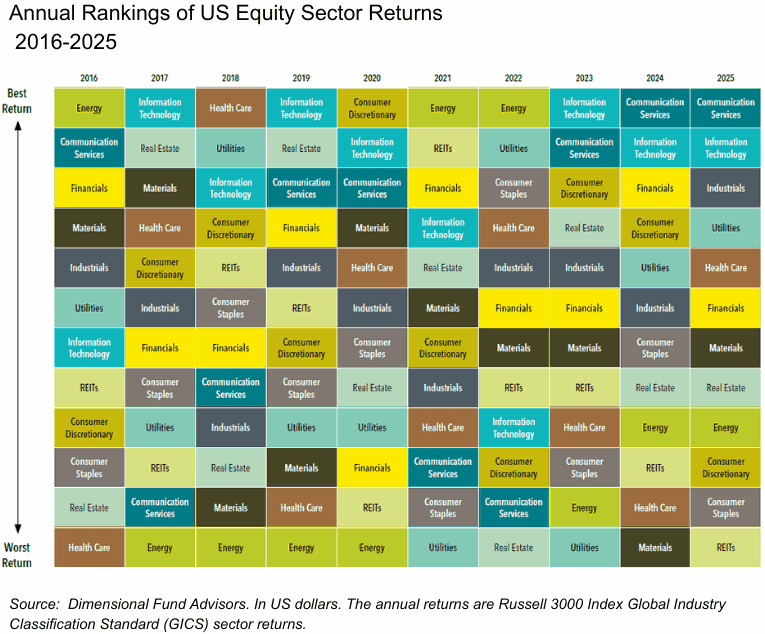
But before you go loading up on AI stocks, look at the chart below3. It shows sector returns in the US market each year over a decade. Yes, communication services and IT have led the pack in the past two years. But as recently as 2021, the communication services sector was near the bottom. And in 2022, both were low-placed.
Building the All-Weather Portfolio
The message is that no single sector has been a consistent outperformer in the world’s dominant market, not only over decades but even just year to year. This makes basing an investment strategy on picking the next star sector a haphazard one. (Incidentally, that’s why you so often hear the disclaimer ‘past performance is not a reliable indicator of future performance’. There’s a good reason for that.)
By the way, the Australian market paints a similarly patchwork picture. A decade ago, Materials and Energy stocks led the field. Last year, it was Financials and IT. During Covid, Consumer Staples and Healthcare topped performance tables.
For individual investors, then, what’s the best response to the lack of consistency in sectoral performance? One word: ‘diversification’. If you can’t see a pattern in the chart above, even by squinting, another approach might be to own them all.
Being diversified means even if you have a few underperformers in your portfolio, but you may also be positioned in the winners. The difference of this approach from ‘putting it all on one sector’ is you may have some protection when that sector cools.
The point about being diversified is that it is something you can control, along with managing your split between growth and defensive assets, your overall level of risk, regular rebalancing with the help of an adviser and, most of all, sticking to your plan.
This way you don’t have to keep shifting your investments for changing terrain. Instead, you have an all-weather portfolio – one made for any climate.
Seek advice
A qualified financial adviser can help you make sense of your options and ensure your super and investments are structured appropriately. Contact us for a complimentary discussion to see if advice is right for you.
References